Saturday, May 19, 2018

Three Americans Out Standing in Our Field


Name: Eileen Connon and Mallory Fox
Hometown: Mandeville, LA and Harrison, OH
Internship: Cape Parrot Project Research Intern
Location: South Africa

Hello from the Southern Hemisphere! Mallory and Eileen here, a little over two weeks into our African adventure and boy, has it been an adventure! From day one, we faced challenges because our original flight to Atlanta was delayed so many times that we were going to miss our connection to Johannesburg. We ended up getting rerouted through Detroit and London before making it down to South Africa a day later than planned, with about two hours to spare before our next connection to East London. Cassie, the research manager for the Project, picked us up at the airport. Dr. Young and Mallory grabbed the rental car and Cassie and Eileen drove in the Project’s “bakkie,” or pick-up truck the two hours to Hogsback. We had a nice, relaxing first night and morning, but no rest for the weary because we helped out with the Cape Parrot Big Birding Day that first afternoon/evening. People all over the country participate in this count annually to help estimate population size. We split up and headed to several different locations around Hogsback. Eileen got the easy spot just up the hill from our house, while Mallory headed out with Craig, one of the owners of the local pub. Dr. Young went with Cassie and took the recording equipment, and Kate, Cassie’s wife and another member of the Project, was supposed to go to another location, but she ended up standing with Eileen after having to save Dr. Young and Cassie from a flat tire. We did the same the next morning. After that, it was time to pack up and get ready for our big trip, because the next day we left for our month of travel around the country, which we’re about halfway through now.
One of the Amapondo backpackers cats!
            On Monday the 7th, Kate, Dr. Young, Mallory, and Eileen all piled into the rental and headed out. Eileen was very uncomfortable for the first hour of the ride, as she had to squish the flat tire between her feet and the seat in front of her until we made it to a tire shop in nearby King William’s Town. By contrast, the leg room for the rest of the trip was much better. That evening we made it to our first stop: Amapondo Backpackers in Port St. Johns. We all shared one big room with a double bed and three single beds and had meals in the communal kitchen next door. We also had three dogs and three cats to befriend, and some interesting people as well.

           
Of course, this isn’t just a vacation. We’re traveling around to record vocalisations of Cape parrots (and eventually grey-headed parrots) in different parts of the country so that they can then be analyzed to determine whether or not different sub-populations have different dialects. We had a tip about an area with lots of hotels/lodges that would have parrots, so we headed over and met the owner of Bamba Lodge and Purple Indigo, who was very helpful! We saw a couple of late parrots fly overhead that evening as we sat with her and her husky puppy and had tea. The next day we headed out to The Jetty, another lodge, and got a lot of vocals! In addition to parrots, we also saw some cool trumpeter hornbills.
on the beach in Port St. Johns
            Over the next few days, we got a lot of really good recordings and had some fun adventures! We went to the beach and a nature reserve. We had so much success, in fact, that we cut our visit short and headed to a place called Ntafufu Ecolodge where they said they had parrots in their garden. The lovely couple who runs it let us stay a night for free! Before we left Amapondo, we met a backpacker called Keegan- more on him later.
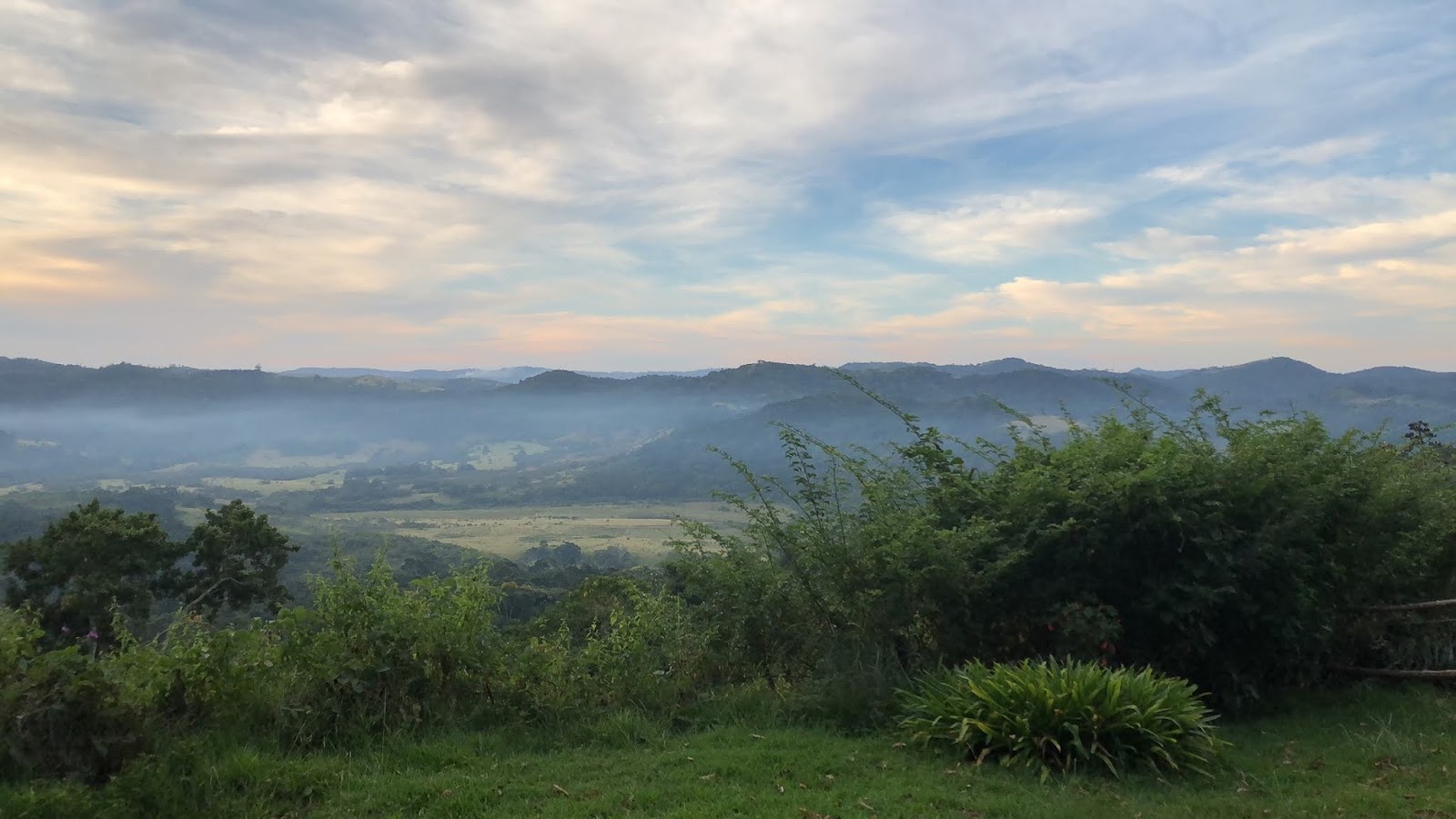
(one of) the views from Ntafufu
            When we got to Ntafufu, we unloaded our stuff and changed into athletic clothers, because we hiked down to the river and canoed to the beach! The river was absolutely gorgeous and so tranquil- it looked like the Disney Jungle Cruise but real. We wanted to be wearing all-khaki outfits and big hats like classic adventure movies. We made it to the beach without any problems, despite Mallory’s threats of capsizing, and ended up being totally alone on the whole stretch. We were in an area of the country called the Wild Coast and you could easily tell. We then had to canoe back to the launch point and hike back up to the lodge, which was harder than hiking down. By the time we made it back, it was just about time to wait for parrots. As we were getting ready, that backpacker Keegan showed up! He had walked from Amapondo to Ntafufu, a drive that took us about an hour, in about 8 hours. He’s apparently walking from South Africa to Morocco! He was also interested to learn about the parrots, so he hung out with us while we got evening recordings. That evening, Sabine and Armin, the owners, hosted us for a “braai”- a South African barbeque. Armin made us this amazing braai flatbread cooked in banana leaves and topped with a tomato butter (tomato paste, butter, and garlic) that was the best bread we’ve ever eaten ever. After several hours of good food and good conversation, we headed to bed in our chalets with paraffin lamps and candles to light our way. We woke up the next morning to get more recordings and then had to head out for our next destination, but not before we said goodbye to the three dogs and one precious puppy that we befriended there!
Ntafufu EcoLodge


Mallory with Grace (in her arms) and Sally (posing)

            Our next drive was pretty long, because we left the Eastern Cape province and headed into Kwa-Zulu Natal. We stayed at the Umzimkhulu River Lodge, which was in fact an hour away from the town of Umzimkhulu and was closer to Bulwer and Underberg. It was pretty cold there- Underberg is just below the Drakensberg mountain range and we could see snow on the peaks! Luckily the lodge had electric blankets for us. We got a lot of recordings around the area, luckily! We went to a sawmill in nearby Creighton and saw close to 100 parrots there, which was super exciting. One morning, we hired a bird guide named Warren to take us to iGxalingenwa Nature Reserve (don’t ask us how to pronounce it), and he took us on some wild four-wheel drive roads in the morning mist. We got some recordings but didn’t end up seeing too many parrots. Luckily, on the drive back, Warren spotted some Southern Ground Hornbills for us! One of Eileen’s goals for the summer was to see them so she was quite chuffed. Kate, Dr. Young, and Eileen headed back to the same forest another day and found easier roads and more parrots!
It's frustrating when we can't find parrots!

Views from the Sani Pass road
With some free time one day, Dr. Young, Eileen, and Mallory headed on the biggest adventure so far: summiting Sani Pass! We went through a guide service and got a ride up 8 kilometers of no-man’s land between South Africa and Lesotho (pronounced Le-soo-too) in the Drakesnberg. We had to hold on tight because the road was bumpy and bendy and turn-y and there were some enormous drops! We made it to the top and saw the rare Drakensberg rockjumper and these tiny little rodents called ice rats. We then got to go to a Basotho (pronounced Ba-soo-too) village where a lovely lady named Belina gave us some fresh-baked bread from her cow dung oven- they don’t have firewood because its too high for trees to grow, so they burn dried cow pats- and sold us some nice souvenirs. We finished the journey at the Highest Pub in Africa-2874 meters above sea level! We had a nice meal and drinks at the top and then headed back down.

Selfie stop with our guide, David

Eileen and Belina, the lovely Basotho woman who welcomed us into her home

At the highest pub in Africa!


After we finished up recordings in Underberg, we drove on to Kate’s parents house for a break before the next leg of our journey, which is where we are now. We stopped in Pietermaritzburg along the way to meet with Professor Colleen Downs, who has done a lot of Cape parrot research, and to get lunch at a curry take-away place called The Curry Pot with one of Kate’s old university friends. Mallory and Dr. Young had cheese and chip roti, which is essentially a wrap with French fries, melted cheese, and gravy. Eileen had a bunny chow, which is a quarter of a loaf of white bread, scooped out and refilled with curry. We then made it all the way to Kate’a parents’ house and have been having a lovely time. We had fish and chips, avocado and butternut salad, and tomato and chickpea salad last night after drinks with Kate’s whole family (sister, brother-in-law, and nephews included). This morning we went to a big farmer’s and craft market for souvenir-buying and snack-eating, and now we’re watching Royal Wedding Coverage before we go to the beach in Durban!
And that's real dirt- not spray-on! 
The whole research crew: (left to right) Cassie, Kate, Dr. Young, Eileen, Mallory


Next up for us is the long drive up to the northernmost campsite in Kruger National Park to look for the grey-headed parrot. Cassie is trading out for Kate so she can head back to Hogsback to handle some stuff at the Project, so he’ll be with us for the remaining two weeks. Look forward to another update from us soon! Lekker!

Cheers!
Eileen and Mallory

Friday, May 18, 2018

China's National Treasure!

Names: Chelsey Butler and Catherine Jenkins
Class Year: 2019 and 2020
Hometown: Williamstown, WV and Proctorville, OH
Internship: Chengdu Research Base of Giant Panda Breeding
Location: Chengdu, Sichuan, China


The entrance into Chengdu Research Base of Giant Panda Breeding


Nî hâo from Catherine and Chelsey at the Chengdu Research Base of Giant Panda Breeding. As our second week of our ten week stay is coming to a close, we have already fell in love with the Research Base and the people here. Giant Panda's are listed as vulnerable on the IUCN Red List. The main threats to the panda populations are human encroachment, deforestation, and other negative human interactions. 


This past week we have worked with many volunteers to help educate the public as well as other foreigners visiting the Base about Giant Pandas. It's a great feeling watching the visitors get excited about learning more on giant pandas, red pandas, and what they can do to help. For the past two days we have informed visitors on the various adaptations that pandas have evolved to better suit their diet. Among the many people we have educated was a local school group from Chengdu. They were so excited to learn from the staff from the Panda Base as well as learn the english names to the animals they already love.
Panda program at the metro station 


Not only have we helped educate the public we have helped the staff review the english throughout the Base, as well as many of their articles. Next week we will be moved to the husbandry department for the rest of May.


Panda Question of the Week!
Which skull shown in the picture is a Giant Panda skull? (Can you identify the other two as well?)

Models shown during our interpretive talk 

Exploring the Base has been an adventure on its own but since we are in China we also wanted to explore throughout Chengdu! We have learned that we are not good at figuring out which bus to take to get to a destination but we have successfully mastered the metro station! Last weekend we visited the Wenshu Monastery, Jinli Ancient Street, and Du Fu Thatched Cottage.


Sunday, May 13, 2018

The Other 70% of the World

Name: Karagan Ross
Class Year: Class of 2020
Hometown: Nashport, Ohio
Internship: Marine Research Intern
Location: Oceans Research, Mossel Bay, Western Cape, South Africa

Being a spotter for our first chumming trip!
As I'm nearing the halfway point of my time here at Oceans Research, I decided it was time for another blog post. Before I get into some of the highlights for this week, I wanted to take a minute to reflect on the past two weeks, as I am honestly in disbelief of all the amazing opportunities I've already had. During one of our first boat trips, one of the field specialists looked at us and said, "Most people never get to explore the other 70% of the world, but now you all can" and that has been stuck with me ever since. It is unbelievable to me that I have this chance to study the creatures that inhabit the majority of our planet. Before I get too tangential in this intro, I'll get into just a few of the amazing shifts I've had this week!

An amazing shot from the head field specialist, Sasha!
This week, we went on two separate chumming trips: one on Monday and another on Friday. While our Monday trip was good, our Friday trip was fantastic! We were able to collect photographic and GoPro data for 6 great whites, and saw one more right as we were about to leave our site (unfortunately, this last shark wasn't around long enough for us to collect any data). Being able to spend this amount of time watching great whites has been such an eye-opening experience. Before this internship I had never thought of sharks having distinctive personalities; however, during our 4-hour observation periods, each shark begins to show their individual traits. For example, some sharks we see are extremely predatory by nature, while others are more investigative. Sharks, especially great whites, get the reputation of big, scary monsters, so seeing these differing personalities really makes you rethink this stigma.

Releasing a leopard catshark!
We also went on two very successful tag-and-release fishing trips this week! We collected data on 10 individual benthic sharks during each trip, and were able to find some other interesting species along the way. On our second trip, I caught a fairly rare Catfaced Rockcod, which we made sure to tag before releasing. We are specifically trying to study leopard catsharks and pyjama catsharks, however we tend to find some smooth-hound sharks during our trips as well. This week, us interns got the drill of how to efficiently collect all of the data we need: put the shark into tonic immobility (to avoid injury due to sudden movement), measure the shark, collect a genetic sample, tag the shark and release it. Last week, the field specialists had to walk us through the steps for each shark, and now we are able to collect everything with little help! One of my favorite parts of this internship is how the field specialists give us the ability to try everything out and learn on our own, instead of having us just sit back and watch them do everything. It's really allowed us to learn how to function together as one unit, while giving each one of us the opportunity to learn hands-on.

Collecting a genetic sample on a pyjama catshark!
On Wednesday, we took to the beach in Hartenbos, a neighboring town, to collect shark and skate egg cases. Sharks and skates are oviparous, meaning they lay eggs, and once these eggs hatch their casings wash up on the beach. We collect these egg cases to determine the abundance of each species we find, while also determining how many of these eggs actually hatched and which were subject to predation or damage.While doing this we also participated in a beach clean, where we found an abundance of cigarette butts, bottle caps and plastic straws lying around. During our analysis, we found we had collected mostly twineyed skate egg cases, but we also had collected a few puffader shyshark cases, one biscuit skate egg case and one extremely damaged leopard catshark egg case! Using the different measurements we took to determine the species of each case turned out to be quite the challenge when we found a case that suffered damage, but in the end we were able to identify all of the 100+ cases we collected!

The last shift I want to highlight is the intertidal survey I took part of on Thursday afternoon. We made a 40m transect using a piece of rope, and every 5m we placed down a metal square to use as our quadrats. At every quadrat, we would identify any species we saw, and the abundance of each species. This got a bit difficult for species like blue coral worms, where we could see more than 200 individuals in a 1 square meter area! For these types of species, we were able to make an estimate (thankfully!) rather than having to count out every individual. Afterwards, since we finished early, one of the field specialists gave us an interesting task: go out and find an interesting species, and use your biology knowledge to tell him its niche. Between the four of us interns, we chose a sea urchin, a black-lipped topshell, a green snail, and a cuttlefish! This really got us thinking about why each individual species inhabits the area it does, and what purpose it serves to the overall ecosystem.

That's all I have for this week! Thank you so much to everyone who has been following along with my journey thus far. Make sure to check out my next blog next Sunday to see what exciting things we will be up to this week!


Sunday, May 6, 2018

Orientations and Oceans!

Name: Karagan Ross
Class Year: Class of 2020
Hometown: Nashport, Ohio
Internship: Marine Research Intern
Location: Oceans Research, Mossel Bay, Western Cape, South Africa

Hanging out with Emma!
Greetings from South Africa! I have just finished the first week of my month-long internship here at Oceans Research, and I can't believe how quickly it has gone. I am one of the four Marine Research interns for the month of May, and we live together in the "intern house", which can hold up to 24 interns! The house has a beautiful ocean view and all of the shark information and pictures your heart can desire. It has quickly become home base for all of us, and when we aren't out working you can find us eating some amazing home-cooked meals from the house cook or playing with the house dog, Emma.


The sunset from the porch is breathtaking!


 Monday through Friday we work from 8am-6pm, with a 2-hour break for lunch, and every morning and afternoon each intern is assigned to a shift."Chum" has quickly become the personal favorite shift for us interns. During Chum, we load onto Oceans' research vessel, Mako, and set out with a camera and a GoPro to collect data on great white sharks. We use the GoPro to get footage of the ventral side of sharks to determine whether they are male or female by looking for claspers, the male reproductive organ. We also take pictures of the shark's dorsal fin to look for pigmentation, scarring, or other identification features. These pictures and videos, along with any other data collected during the shift, are entered into a computer after our shift and are stored in a database with all previous chumming trips. Oceans isn't just about sharks though! Some of our other shifts include tag-and-release sea fishing, dolphin surveys, tidal pool population studies, and husbandry shifts at the local aquarium. Every day is a new shift, and each shift is completely different from the last, so you never know exactly what you will be doing that day!

Our first day here was filled with orientations and lessons to prepare us for our upcoming month. We met the six field specialists who work for Oceans Research, and also learned about each of the projects we would be working on. After lunch, we went down to the harbor to activate our harbor passes, and practice some of the boat skills we had learned that morning (such as how to drop an anchor and tie-off the boat). We were even lucky enough to watch a seal predate on an octopus as we were leaving the harbor! We then headed to the local aquarium and became familiar with the species which they housed. Once we became oriented with the locations and projects, we were finally able to start our first shifts!
We were able to snap a couple of pictures after cleaning out the shark tank!

On the first day of our work, I was sent down to the aquarium with another intern to do some general husbandry. The majority of our time was spent catching sand shrimp to feed to the resident triggerfish and performing water changes to their tanks. Sand shrimp are tiny, transparent crustaceans which live in the small intertidal pools along the beach, so they are hard to spot without paying close attention. Every 15 minutes, we would stop catching shrimp in order to change out some of the triggerfish's water. Afterwards, we fed blue mussels (an invasive species!) to the starfish in the aquarium, making sure to avoid to greedy octopus Indigo while doing so. Then, we were able to clean out the windows of the smooth-hound shark tank! The aquarium offers a "swim with the sharks" encounter, so we were easily able to clean off their windows while they swam around us. The water was only 20 degrees Celsius though, so afterwards we enjoyed a coffee on the beach. We even saw a rock hyrax enjoying some grass in front of the aquarium!

Watching the puffer fish necropsy!
Our afternoon was spent learning about the proper technique to use while tag-and-release fishing. We learned how to build a trace (the way to connect a hook and sinker to your fishing line), what types of measurements we would be taking, and how to properly release any animals we had tagged. After our lesson, we got to watch a field specialist perform a necropsy on a puffer fish! The puffer fish, Tetraodon nigrivitis, belonged to Oceans' director, and had suddenly died that day in his aquarium. Fun fact: this species of puffer fish has the smallest known vertebrate genome, yet has the same number of genes as a human! After studying the fish, they noticed that the gills and heart of the fish were very white, indicating they had no blood in them. The field specialist determined that the fish had the equivalent of a heart attack, which led to its death. I had never watched a necropsy on an aquatic animal, so getting to learn the inner anatomy of the puffer fish was such an exciting experience!

Collecting data on the eagle ray!
We were finally able to get out on the boat on our second day of work. Our morning was spent chumming for great white sharks, and was just as amazing as I had hoped it would be! We only saw 2 sharks during our 3-hour trip, and were only able to collect data for one. That shark, however, was within sight of our boat for an 1 1/2 hours! Being able to see a shark that close up was absolutely mind-blowing, and reinforced my excitement for the rest of this month! After studying our GoPro videos, we determined the shark was a juvenile female. For our afternoon shift, we headed back out to Mako to try our hand at sea fishing! After practicing the traces we had learned the day before, we baited up and got to work. Unfortunately, we only had 5 catches during our 4-hour trip, and only 2 of them were species of interest. We caught a juvenile smooth-hound shark, which we took length measurements of and collected a genetic sample from before releasing. Our most exciting catch was an eagle ray with a disc width of 75cm! These rays have a large barb on their tail, so we first had to make sure we wrapped a towel around the tail to prevent any injuries to ourselves. We also collected a genetic sample from this ray, and tagged it using a small, thin tag aptly called a spaghetti tag. The ray was our final catch of the day, so we were able to end the day on a strong note!

Pumpkin pancakes from an all-vegan food stall!
After our shift Friday night we had a welcome braai, which is Afrikaans for barbecue. The house cook prepared amazing South African cuisine, which we enjoyed around a fire on the house's back porch. South Africa is currently in their winter months, but their winter is nothing like an Ohio winter. The daily temperature has stayed around 22 degrees Celsius, which makes for beautiful sunny working conditions! We have weekends free, so Saturday morning us interns headed to a farmers market about an hour away from campus. The market was full of homemade arts and crafts, and delicious homegrown produce. We were able to shop for friends and family (and ourselves too!), and enjoy some amazing food from the different vendors around the market. When we aren't going on an excursion, we take a 15-minute walk down to the beach and enjoy the beautiful weather. While the water is a little too cold to swim in, we are still able to enjoy some sunshine and the beautiful scenery. This is only the beginning of our month of adventures, so be sure to check in to my future blog posts for more updates!


Friday, September 1, 2017

What Matters the Most

Name: Rebekah Perry
Class Year: Junior
Hometown: Huntington, WV
Internship: Wildlife Rehabilitator at New Mexico Wildlife Center
Location: Espanola, New Mexico

Now that the rest of my summer has flown by extremely quick, and school is back in session, I wanted to take the time to unpack my internship experience from a completed point of view. What did I get out of being on the other side of the country for 10 weeks?

Wow. I become overwhelmed by the fullness of my time spent out west every time I start to decide what to write. Therefore, I think I might begin this post with sort of a "brain dump" of things that stick out about this summer, and then wrap them up into what I learned matters the most.

Something really interesting and very insightful that I got to do during my second half of the internship was work on a cost analysis project for some of the most common cases that came into the center. The goal of my research was to gather every cost that a patient admitted to the New Mexico Wildlife Center accumulates throughout its time there, beginning to release, and have that information to better inform the public of the astonishingly high prices of rehabilitation, so that they could then donate accordingly. Donations are the main source of funding for most wildlife centers, and many people do not realize the scope of how much each animal costs.  Did you know that the diet of just one orphaned baby bobcat, that must be kept for 7 months, is $1,172.12 ? Or that a group of six orphaned squirrels will eat $375.76 of food in 8 weeks? And who would have thought that just 5 tiny insectivorous songbirds will eat $140 worth of meal worms during their stay?

Another exciting part of the last half of my summer was getting to see many of the animals that we had worked with all summer long return home to the wild. Perhaps the most rewarding release to do was of the four stubborn and sassy barn owl siblings that had been raised successfully from abandoned hatchlings to independent adults in the time that we were there. After weeks of going from force feeding, to hand feeding, self feeding, and finally killing live prey in mouse school, the birds got to be released by all of us interns on the second to last week of our summer. We knew that when it took literally two hours to catch them all up out of their huge flight mew outside (because they were such good fliers escaping our nets and no longer dependent on our care) that they were going to do wonderfully in the wild.

But as always mentioned before, it was not all fun and games for the last five weeks. A very sobering feeling in the field of wildlife rehabilitation is when you realize that you cannot always afford to play hero all of the time. When money is tight and the patient load is full, sometimes animals come in too far gone to try and rescue. That lesson is a devastating one to learn, and every single heart in the clinic ached for the lives of those patients to live on, but great value did come from their souls passing: sometimes it takes rock hard reality to remind you why we as the human race really need to come together to defend and protect our wildlife through our actions, philanthropy, and educating others. One of our staff members had the idea to light a candle every time the life of an animal was put to rest, as a way of honoring them and acknowledging that they were missed.

So I promised that I would wrap all of this up with what I discovered matters the most. People. People are what matter the most. Now some of you might be like, "What? I thought you spent your whole entire summer saving wildlife? Shouldn't the animals matter the most?", and that is not necessarily what I am saying. Obviously the animals matter, and their conservation is the key reason that an organization like the New Mexico Wildlife Center exists. But their lives will never be conserved if people are not connected, and that connection can take many different forms. It can look like the incredible ICU staff dedicating the better half of their every single day to the critical care of animals that have been injured or orphaned in the area. It can also look like the hard working office manager answering phones for wildlife emergency calls and hosting guests. It looks like volunteers who come to take care of the animals used for public education and it looks like the education staff running kids camps and events. But it also looks like the little girl who called the center at about 7pm at night when I was working, who wasn't even old enough to know exactly what town she lived in, but knew when to realize that a baby bird had been orphaned, and informed me that she had been checking on it all day from her window to see if its parents would come back for it, and hadn't seen them. It also looks like a famous author who notices when his neighbors have shot a mother bobcat that had been caring for her two cubs in his back yard and then traps the cubs and brings them in to the center, and writes a very generous check for their funding and proceeds to use his position to tell his fan club to donate a certain sum to the NMWC in order to receive a signed copy of one of his books.

Wildlife Rehabilitation brings hope. Hope, not just for the animals that pass through, but for everyone involved. People, when banded together, can be a strong force for evil, or an invincible force for good. And in a world that sometimes looks hopeless and dark, we can band together to make a difference by conserving the lives and biodiversity of our wild neighbors, something that we all share a positive connection with. Wildlife rehabilitation can reshape the way people view the life of an animal, and their own lives as well. A second chance for all: we can make a real difference. We can choose to do good. That is what matters the most.

Tuesday, August 22, 2017

Introductions, Behavioral Observations and Wild Art

Name: Haley Wasserman
Class Year: Junior
Hometown: Medina, OH
Internship: Enrichment and Research
Location: Toledo Zoo, OH

A lot has happened since my first post about my internship at the Toledo Zoo! I have been working as an enrichment and research intern in the zoo's animal behavior department this summer. There have been some major changes to my daily routine since the first half of summer.

For starters, we have been introducing a new female gorilla to our troop of Western lowland gorillas. The zoo's troop now consists of four females and one silverback. The amount of information I have learned about gorilla behavior within the past few weeks from being involved in these introductions is amazing. Sufi is the newest gorilla and she is 16 years old. She arrived at the zoo in May, but went through a quarantine period to make sure she would not be bringing in any health issues that could be transmitted to the other gorillas. Once Sufi's month long quarantine had passed, she was shifted into the indoor holding for the gorillas and set up in an area across from the troop so that all of them could see each other and get used to each other. After a week, all three of the females were individually placed with Sufi one at a time so that they could become acquainted. The keepers explained to me that this way when Sufi meets Kwisha the silverback, if things get too rough with the introduction, then the females will make Kwisha back off and protect Sufi.
Silverback Kwisha investigating some sand pile enrichment.

I have been able to witness some gorilla behavior in person through observations for these introductions that have taught me so much. I have seen interesting displays such as chest beating by our females, charging, and when the gorillas are feeling tense I can see how their gait changes to become stiff and flexed.

Female gorilla Nia Lewa likes to cover herself in browse!

I have also been doing research on exhibit usage and behavior in our juvenile Galapagos tortoises. There are three juveniles who are growing rapidly and will soon be in need of larger exhibits. I began doing focal sampling to create an activity budget for each individual to see what they spent their days doing and in which areas of the exhibit they spent their time. This will help Zoo staff determine the tortoises’ needs in their new exhibit.
Two of the juvenile Galapagos tortoises.

Why go all the way around a conspecific to get where you're going if you can just crawl over top of them?

As an intern in the behavior department, I have also been asked to aid in some behavioral observations in some departments around the zoo. I have been doing observations on our female African elephants during introductions. The first step, which I have been observing, is to allow 6-year-old Lucas to go back and forth between two exhibits with different female elephants. We observe to make sure his mother, Renee, is comfortable with him spending time with the other female. I take shifts with the other interns to keep an eye on her for the elephant keepers. I have also been collecting data on the behavior of the zoo's two brown bears and Kodiak bear. They are all juveniles and live together and have begun to show signs of what could eventually lead to stereotypic behavior. Stereotypic behaviors are those that occur in an invariant pattern and do not appear to have a true function. We have begun to monitor the bears’ behavior in an effort to determine behavioral triggers and see what we can do to modify this.

I have also been spending time preparing some special enrichment for an event we had the first weekend of August called Wild About Art. This event brought in artists from all over the country to set up tents and sell their work. The animal behavior department ran a booth, so I worked with the other interns to create some “artsy” enrichment to have on display. This list included a box zebra, a paper mache "artist's palette", polar bear "sushi", gelatin bird treats, grapevine wreaths filled with nesting material, and even a giant, plastic pool pickle! I had a great time helping out with the event and meeting some of the very talented artists who had come up for the event.


A box zebra I made out of cardboard tubes, boxes, and a mache paste made of flour and water.. The paint on top is non toxic and a keeper can fill the box animal with meat to give to one of the carnivores to "hunt"!


A grapevine wreath which I weaved nesting materials in to for bird enrichment. Pictured is twine, shredded paper and some reindeer fur!

We typically give these PVC feeders to monkeys, but this one is filled with candy for children to use and see if they can get food out as well as a monkey can!

A "pool pickle", which has been chewed up quite a bit by the tigers.

As my final week of my internship comes to a close, I can't help but think of all of the amazing one-of-a-kind experiences I have had at the Toledo Zoo this summer. I have met so many fabulous people and learned so much information, and can even make enrichment items from start to finish now. My favorite thing about my position was how much I was able to work with a variety of areas of the zoo instead of one specific region. This helped me learn more about zoo keeping for animals that I had no idea I would grow to love working with so much, and being able to speak to so many zoo keepers. Each has taught me more about the world of zoology and has given me amazing advice for the future. Beth has been an amazing supervisor and has given me an opportunity to branch out and utilize everything I could this summer at the zoo. Her encouragement and optimism has helped me immensely this summer and has made it one of the best summers of my life. I will never forget my summer as a behavior intern at the Toledo Zoo.

Sunday, August 20, 2017

Enrichment at the Tembo Trails

Name: Amber Pitsenberger
Class Year: 2019
Hometown: Danville, OH
Internship: Animal Behavior and Large Mammal
Location: Toledo, OH

In my last post, I talked about how I spend my mornings at the Toledo Zoo. For this post, I am going to explain how I spend my afternoons. In the afternoons, I return to the Museum of Science and work with the Animal Behavior Department. One of the things I do is make enrichment for all of the animals that I work with in the mornings. I explained in my last post that enrichment is any item or activity used to enhance the quality of life of the animals living at the Toledo Zoo. Enrichment is used to help keep the animals fit and encourages natural behaviors.  When designing enrichment, we look at the animal's natural history. An animal's natural history provides information the animal's diet, social structure, behavior, and habitat in the wild. This makes it easier to create enrichment items that will encourage natural behaviors and allows the public to see how an animal in the wild might spend it's time. 
Holding the hammock that I made for the meerkats.

I mentioned in my last post that sloth bears eat insects like ants and termites. This means that they use their long claws to dig up the insects. To encourage this behavior, some of the enrichment items given to Kara, the sloth bear, are pieces of wood with food stuck inside holes that she has to work to get out with her claws and tongue. There are also large hollow logs placed inside her enclosure that allow her keepers to place parts of her diet inside. This not only encourages Kara to dig at the logs but it also encourages her to investigate her enclosure more to make sure that she has found all of her hidden treats. Making enrichment for all of the animals I work with can keep me pretty busy but it is really rewarding to watch an animal use the enrichment you made for them. Sometimes we reuse materials to make enrichment items. Recently, I made a hammock for the meerkats using PVC, grommets, and an old vinyl banner we found. We put it into their enclosure and they seemed to enjoy using it.

Meerkats using the hammock.

The behavior department also helps to educate the public about enrichment and why it is important for the animals at the zoo. In June, the zoo was celebrating one of the elephant's sixth birthday. Haley and I attended the event and stood beside a poster that had pictures of some of the enrichment that is made for the elephants at the zoo. This gave guests at the zoo a chance to see some of the enrichment items that we make. We were able to talk to the guests and explain what the behavior department does with enrichment and we had a game that the kids could play. It was a lot of fun. On Father's Day, we made signs and placed them on the enclosures of the animals that were fathers. The sign helped explain if the male of a species spends a lot of time, some time, or no time helping rear young. We then provided enrichment items to these animal dads.
Haley and me talking to zoo guests about the Animal Behavior Department.

My latest project with the behavior department is to help conduct a welfare assessment on the dingoes at the Toledo Zoo. Welfare assessments take into account physical health, mental stimulation and behavioral diversity and help the zoo understand how an animal spends its day at the zoo and what helps it to thrive. It also helps the zoo see if any changes need to be made to help increase the welfare of the animals.

That is what I do for most of my afternoons at the Toledo Zoo. I enjoy making enrichment for the animals that are on the Tembo Trail. It's hard to believe that the summer is almost over.

The tigers' keeper placed shampoo in the tiger pool to create bubbles.